
Longitudinal Care Needs a Lower-Cost Operating Model

Healthcare has more information about patients than ever before.
But having more information is not the same as finding the signal that explains what is happening.
As patients live longer and manage more chronic conditions, their care increasingly unfolds across years, organizations, clinicians, and systems. A single patient may have multiple specialists, medications, referrals, diagnostic tests, hospital encounters, and unresolved follow-up needs.
Different Industry. Same Systems Problem.

Healthcare has a capacity problem.
Care delivery has changed dramatically. More care now happens across teams, locations, systems, and between visits. Patients are living longer with multiple conditions. Clinics are responsible for more information, more follow-up, and more longitudinal care than ever before.
But clinical capacity has not expanded at the same rate.
Primary care has a data plane. It needs a control plane.
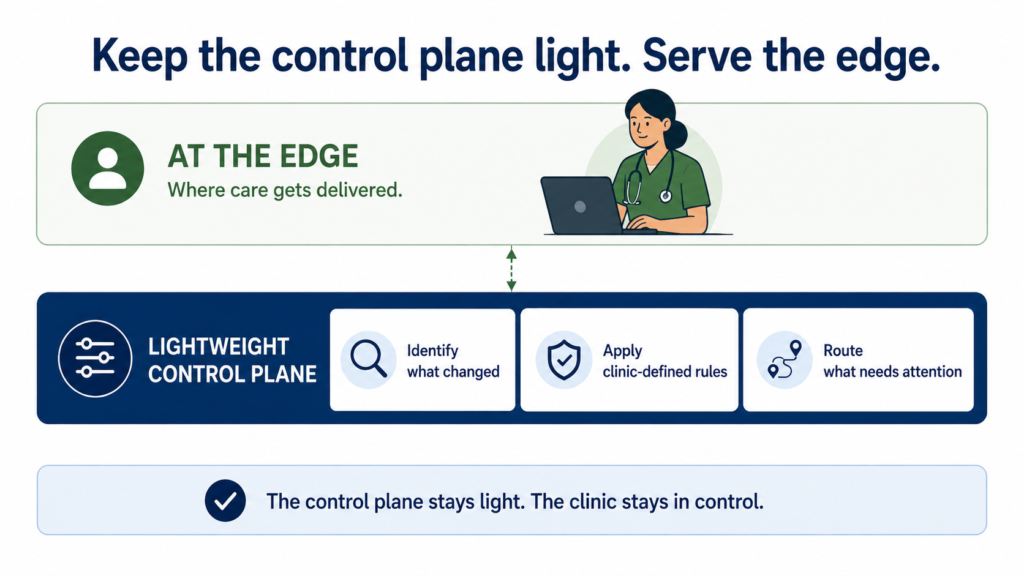
I spent about two decades in telecom infrastructure—at Cisco, Redback, and Ruckus—during the shift from landlines to mobile networks. Landline systems were built for fixed phones in fixed locations. Mobile changed that in two ways at once: people and devices began moving across towers and networks, while those same devices started generating and consuming enormous volumes of data.
From Paper Charts to Bottlenecks: A PA’s Perspective on Reclaiming Time

Ursamin’s Founder and CEO, Shannon Aylesworth, sits down with Craig Hocum, a retired Physician Assistant with deep experience in primary care, nephrology, and oncology. Craig offers an expert view on the industry’s most challenging pain point: the workflow bottleneck that leads directly to burnout. The Unmanageable Workload The core problem, Craig explains, is that the […]
From Telco to Transforming Healthcare: The Journey of Ursamin’s Founder on The K in Klarity Podcast

On “The K in Klarity” podcast, Ursamin’s CEO and Founder, Shannon Aylesworth, shares her unique journey from building high-performance tech platforms to transforming healthcare. Learn how she applies a clear data architecture to simplify health data management and reduce administrative burdens for clinicians.
Ursamin – Leading the Surge in Healthcare Innovation

Ursamin is leading the surge in healthcare innovation, capturing 42% of the investment spotlight in a shifting market. As a late-stage pre-seed opportunity, we offer investors a fast track to a quick exit in a booming sector. Join us to transform healthcare—read more now.
Care Coordination vs. Case Management: Untangling the Similarities and Differences

Care coordination vs. case management: Explore their distinct scopes and how they impact patient care.
Springboarding to Success: Ursamin’s Venture with Female Innovators
https://youtu.be/6JV8bTPFKQE Shannon’s journey is a testament to the power of community and mentorship in overcoming the hurdles women founders face. With less than 3% of VC funding going to women-led ventures, the need for initiatives like Springboard is more pressing than ever. Through specialized paths and small cohort-based support, Springboard Enterprises not only aids women […]
Project Healthcare: A Hub for Healthcare Startups

In the latest episode of Unlimited Access broadcasting from Nashville, Shannon shares her firsthand experiences at the kickoff of Project Healthcare, an innovative hub for healthcare startups. Collaboration Among Startups One of the episode’s highlights is the emphasis on the unique collaboration among different startups. Shannon speaks about the synergistic relationships formed between companies, each […]
Unique Challenges in Pediatric Healthcare: Insights from Dr. Laura Cardello on Unlimited Access

In this Unlimited Access episode, Dr. Laura Cardello shares personal stories on the unique challenges and triumphs in pediatric care – and how technology plays a critical role navigating care.