
Why the next decade of primary care looks a lot like the last two decades of telecom — and what that tells us about where the work goes next.
By Shannon Aylesworth · Founder & CEO, Ursamin
I spent about two decades in telecom infrastructure—at Cisco, Redback, and Ruckus—during the shift from landlines to mobile networks. Landline systems were built for fixed phones in fixed locations. Mobile changed that in two ways at once: people and devices began moving across towers and networks, while those same devices started generating and consuming enormous volumes of data.
The old architecture was not built to manage both that movement and that scale. Telecom responded by separating two jobs. The data plane carried the traffic. The control plane provided the intelligence that determined how that traffic should move. Once those functions were separated, the network could scale in ways the old architecture never could.
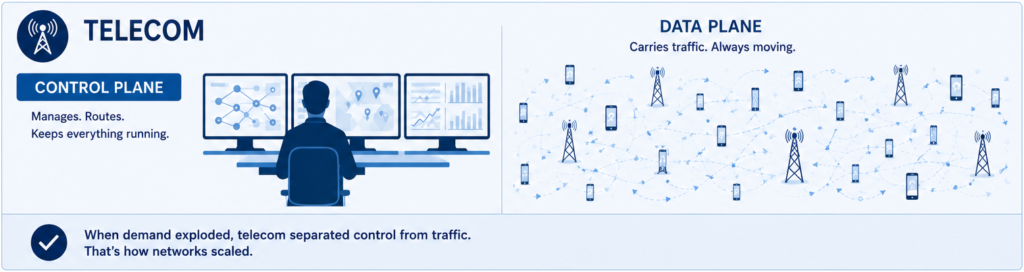
Healthcare is telecom, about fifteen years later. And primary care, right now, is running without a control plane.
The record is the data plane
The electronic medical record is a magnificent data plane. It captures everything: every encounter, every lab, every note, every referral, every billing event. By design, it preserves history — a single patient can generate something like 80 megabytes of it a year, and the record dutifully keeps all of it.
But storing everything is not the same as knowing what to do next. And “what to do next” is now most of the job.
Doctors used to be responsible for the visit. Now they’re responsible for the whole patient — the weeks and months between visits, when chronic conditions are managed, treatment plans shift, referrals need closing, multiple medications need oversight, and patients risk getting lost in the shuffle between offices. That work is coordination, and coordination is a control-plane problem. The record was never built to be a control plane. So something else became one.
People did.
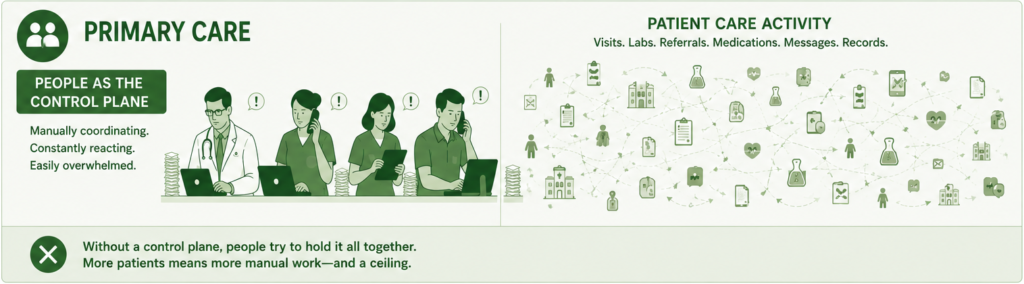
When people are the control plane, it doesn’t scale
Walk into a primary care clinic and you’ll find the control plane running on human beings. Someone pre-preps every chart by hand before a call. Someone reads a year of history to find the one thing that changed. Someone re-keys a care event into billing. Most of that data — call it 97% — is historical, administrative, or repetitive. Only a sliver, 3% or less, is what actually changed and needs action. Finding that sliver is manual, and manual work doesn’t scale. Here’s the part that gets missed: this is non-clinical work, but it lands on clinical people. The physician spends a day a week on administrative review. The nurse hand-charts every plan. Coordinating one complex patient has grown from roughly twenty minutes to four hours or more, and it increasingly falls to whoever is free — clinical or not. Adding care means adding people. The clinic hits a ceiling not because it runs out of patients, but because it runs out of hands. That is the exact wall telecom hit before we separated the planes.Keep the control plane light. Serve the edge.
The answer in networking wasn’t to make the data plane smarter. It was to separate the planes: let the heavy data live close to where it’s used, and let a light control plane do the deciding.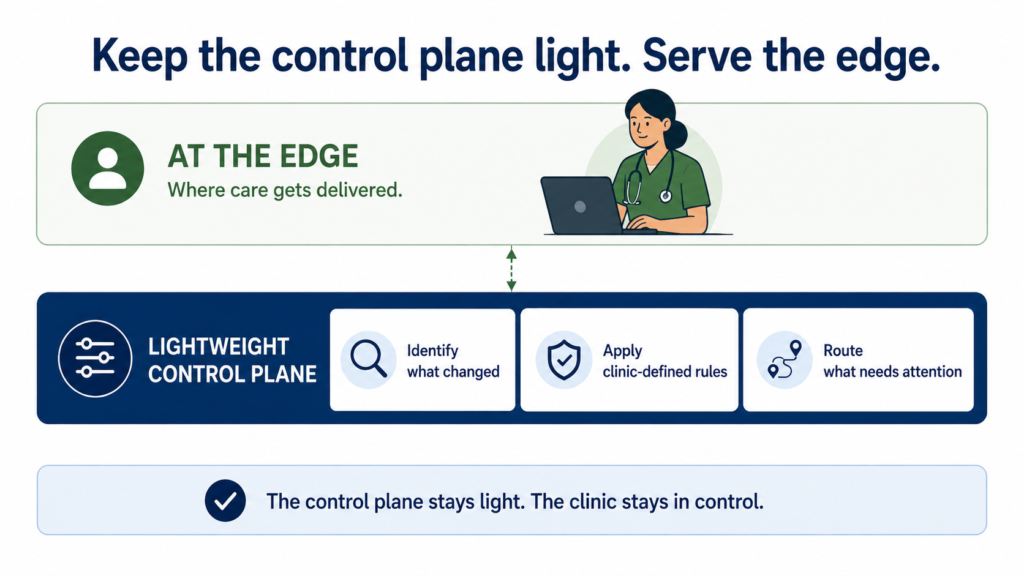
That’s the map for what we’re building at Ursamin. The record stays exactly where it is — we’re not another repository. Ursamin is the control plane above it: light by design, because deciding what needs action is a fraction of the traffic of storing everything. It reduces the flood to only what changed and may need action, and delivers that sliver to the person at the edge — the clinician, the coordinator — who needs it. And here’s the part that matters most: the policy lives with the clinic. Each practice sets its own workflows, its own care model, its own rules for what gets surfaced to whom. The plumbing can be shared; the control belongs to the clinic.
When the control plane does the sorting, the human work changes shape. Coordination stops being a headcount problem. The goal we drive toward is blunt: the number of people it takes to keep a panel on track should fall — and keep falling — even as the panel grows. Grow care levels without growing admin, because the admin was mostly data-sorting, and data-sorting is exactly what a control plane is for.
Come build it with us
We’re building this with clinics, not just for them — a growing community of primary care practices and extended supporting teams, co-developing the operational layer their world has been missing. If you’ve felt that ceiling, where doing more for patients means hiring more people or bolting on another clunky tool, that’s the wall we’re taking down.
Primary care has a world-class data plane. It’s time it had a control plane too.