Why a team shaped by telecom sees healthcare’s capacity crisis differently
By Shannon Aylesworth · Founder & CEO, Ursamin

Healthcare has a capacity problem.
Care delivery has changed dramatically. More care now happens across teams, locations, systems, and between visits. Patients are living longer with multiple conditions. Clinics are responsible for more information, more follow-up, and more longitudinal care than ever before.
But clinical capacity has not expanded at the same rate.
The result is predictable: overloaded teams, missed signals, incomplete follow-up, and patients not getting the care they need.
At Ursamin, this problem feels familiar.
We have seen this kind of transition before
Members of our team spent years in telecom—an industry that underwent its own fundamental transformation as mobile phones moved from a specialized technology to something nearly everyone carried. Suddenly, people expected to communicate and access information from anywhere, creating an explosion in usage, data, and network complexity.
Demand exploded. Usage patterns changed. Networks became more distributed. Yet capacity remained constrained.
The answer was not simply to keep adding more infrastructure.
The industry had to learn how to manage its existing capacity differently. That required understanding demand, recognizing changing patterns, prioritizing traffic, balancing load, routing intelligently, and coordinating activity across an increasingly complex network.
Healthcare is facing a remarkably similar systems problem.

And instead of a dropped call or degraded service, the consequence can be a patient who does not get the care they need.
The problem is not a lack of effort
Healthcare teams are working extraordinarily hard.
The problem is that the current operating model was not designed for the way care is delivered today.
Most clinics are expected to coordinate increasingly complex care using systems built primarily to document individual encounters. Information may exist, but it is scattered across records, providers, organizations, and timelines. The work required between visits is often left to people, spreadsheets, inboxes, and memory to hold together.
That is not a clinical failure.
It is a systems and operations problem.
And it is why we do not begin with the assumption that clinics simply need more staff, more dashboards, or more data.
Making limited capacity work better
Clinics cannot manufacture more hours in the day. But they can use their available capacity more intelligently.
That means helping care teams:
- Understand what is happening across the patient panel
- Identify changing patient needs earlier
- Prioritize attention based on clinical need and urgency
- Coordinate work across people, systems, and locations
- Ensure that important follow-up does not disappear between visits
- Deliver more proactive and patient-centered care
This is not about reducing patients to network traffic. It is about applying what we learned from managing other complex, capacity-constrained systems to help healthcare work better for the people inside it.
When clinics can see and organize the work more clearly, their teams can spend less time searching, reconstructing, and reacting—and more time delivering care.
Better care can also create a healthier clinic
There is an important economic consequence to this work.
When clinics are able to consistently deliver the care their patients need, they can also capture revenue tied to work that is often performed but not operationalized, documented, or reimbursed effectively.
Better care.
Better use of limited capacity.
A healthier operating model for the clinic.
Imagine that: healthcare teams being rewarded for doing the right thing for their patients.
Why this team - and why now
Our team has spent decades working through major infrastructure transitions in which demand outpaced capacity and the old operating model could no longer keep up.
We learned to recognize patterns across large, complicated systems. We learned how to separate signal from noise, manage constrained resources, and build the intelligence and orchestration required to help an entire network operate more effectively.
Those lessons do not give us all the answers to healthcare. Clinical care is deeply human, and improving it requires close partnership with the people delivering it every day.
That combination gives us a different lens through which to see the problem—and a disciplined way to build the solution.
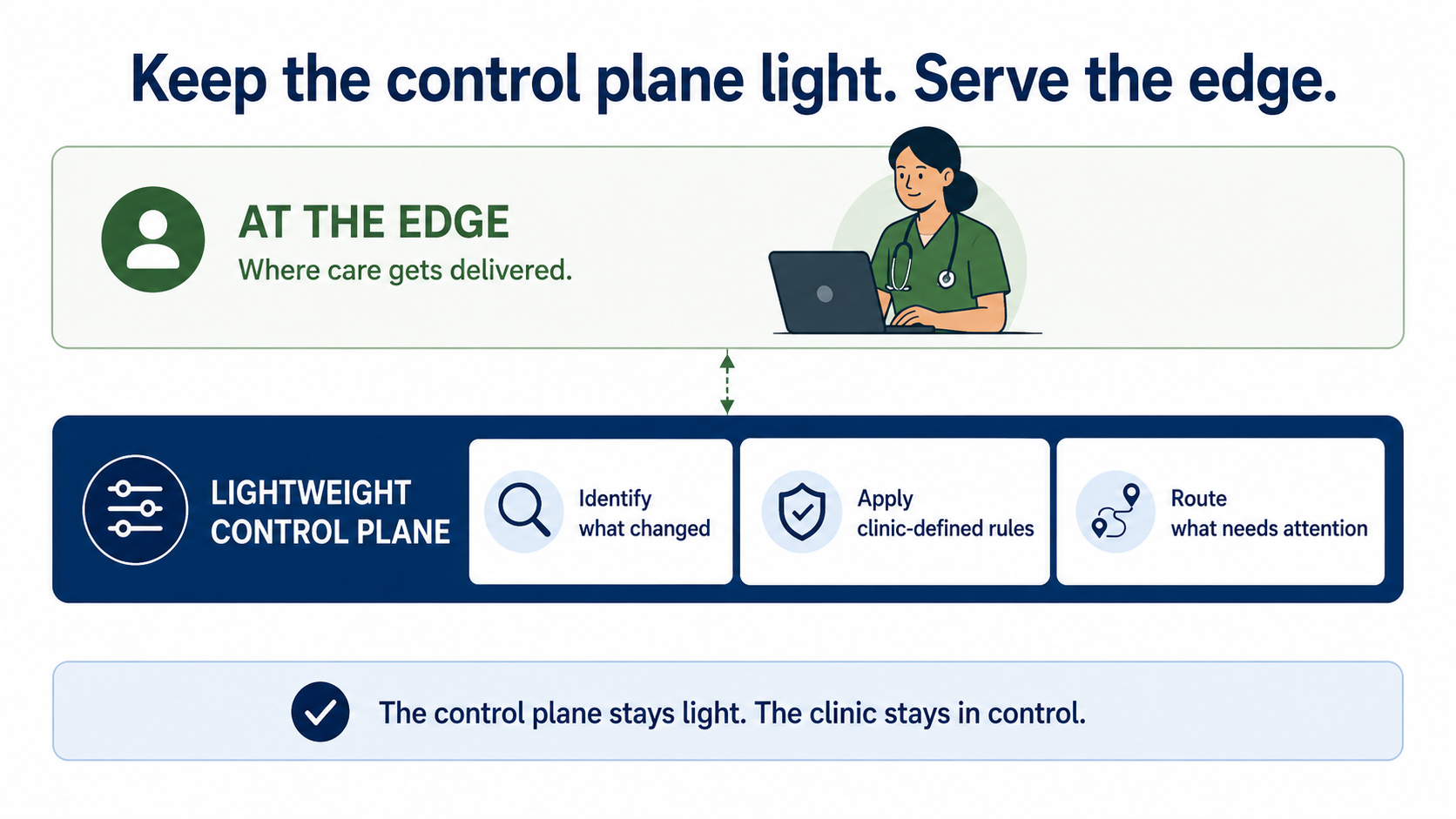
Healthcare does not need another disconnected tool. It needs an operating layer capable of helping clinics understand patient needs, coordinate the work surrounding those needs, and make better use of the capacity they already have.
Healthcare is entering its own major infrastructure transition.