How technology can take on more of the work of reconstructing the patient story—helping existing care teams scale their capacity as patient complexity grows.
By Shannon Aylesworth · Founder & CEO, Ursamin
Healthcare has more information about patients than ever before.
But having more information is not the same as finding the signal that explains what is happening.
As patients live longer and manage more chronic conditions, their care increasingly unfolds across years, organizations, clinicians, and systems. A single patient may have multiple specialists, medications, referrals, diagnostic tests, hospital encounters, and unresolved follow-up needs.
Every interaction adds another piece to the record. But the record rarely separates signal from noise or assembles those pieces into a coherent story.
The signal in the patient’s story is getting harder to find
The medical record was largely designed to document individual encounters. Longitudinal care requires something different: an understanding of what has changed over time, what remains unresolved, and what needs to happen next.
Those answers may be distributed across office notes, specialist consultations, hospital records, laboratory and imaging results, medication changes, referrals, orders, patient messages, and care-management documentation.
Even within an individual note, the newest or most important development may be buried beneath templated history, copied information, and previously documented findings.
This is not merely anecdotal.
JAMA Network Open: Note length and redundancy — A study of nearly three million outpatient progress notes across 46 specialties found that median note length increased by 60.1% between 2009 and 2018, while median redundancy increased from 47.9% to 58.8%. By 2018, only 29.4% of note text was directly typed; the remaining 70.6% was copied or generated from templates. The authors warned that increasingly long and repetitive notes could limit their usefulness in patient care.
JAMA Network Open: Duplicate information in the medical record — A separate analysis of more than 104 million clinical notes found that 50.1% of all text was duplicated from earlier documentation. The proportion of duplicated content rose from 33% in 2015 to 54.2% in 2020, and larger records contained progressively more duplication. The researchers concluded that duplication and scattered information make it difficult to find and verify the clinical signal in everyday work.
The problem is no longer a lack of data. It is the growing amount of human effort required to find the signal inside it.
Complexity creates clinical and operational risk
This matters because longitudinal care depends on recognizing change.
Was the referral completed? Did the abnormal result receive follow-up? Was a medication changed after the hospitalization? Is the patient’s condition worsening across several encounters? Has another clinician already addressed the issue? Does someone still own the next step?
When the patient’s story is scattered across encounters and systems, every clinician or staff member must spend time reconstructing it. When that reconstruction does not happen completely, important information can be overlooked, work can be duplicated, and responsibility can become unclear.
The consequences are not limited to staff burden.
Annals of Family Medicine: Continuity and hospital utilization — Research involving older adults with three or more chronic conditions found that greater continuity of care was associated with lower hospitalization rates.
BMJ Open: Continuity of care and mortality — A broader systematic review found that greater continuity with physicians was significantly associated with lower mortality across different countries, health systems, and specialties.
These studies do not prove that record complexity alone causes poor outcomes. But they reinforce an important point:
The ability to understand and manage the patient’s story over time is part of the care itself.
Today, humans assemble the story manually
Healthcare organizations compensate for this complexity by adding people.
Nurses review hospital records. Care coordinators track referrals. Medical assistants search for results. Clinicians read through prior notes. Practice managers create spreadsheets and work queues to monitor what remains incomplete.
These people are not unnecessary overhead. They are performing an essential function that the underlying infrastructure does not adequately support.
They are turning disconnected information into an understanding of what happened, what changed, what matters now, what remains incomplete, what needs to happen next, and who should take responsibility.
But as the number of patients, conditions, records, and care transitions grows, the human effort required to reconstruct each story grows with it.
More patient complexity → more information → more review → more labor → more cost
AI can help reconstruct the story—but it needs the right foundation
Artificial intelligence can play an important role in creating a lower-cost operating model for longitudinal care.
AI can help extract events from unstructured notes, organize them across time, identify meaningful signal and change, detect unresolved needs, and reconstruct the patient’s evolving story.
But giving AI access to more documents is not enough.
Patient records contain duplicated information, conflicting dates, outdated medication lists, delayed outside records, and plans that may have been documented but never completed. Without the right structure and context, AI may not know what is current, what is copied, what is missing, or what actually happened.
Journal of Biomedical Informatics: Note bloat and AI performance — Researchers have shown that note bloat can also impair the performance of deep learning-based clinical prediction models. The same noise that makes the record difficult for people can make it harder for AI to identify the right signal.
That is why AI must work together with a reliable data and operational foundation.
The underlying system must preserve where information came from, distinguish verified facts from AI-generated inferences, align events over time, and track whether expected actions were completed. AI can then help interpret the record—separating meaningful signal from repetition, identifying what changed, explaining why it may matter, and showing what requires human attention.
The objective is not simply to summarize the chart. It is to create a reliable longitudinal understanding of what happened, what changed, what remains unresolved, what should happen next, and who needs to take action.
That understanding can then be used to prioritize patients, prepare the record for review, automate appropriate administrative work, and bring decisions requiring clinical judgment to the right person.
AI can help tell the patient’s story. The infrastructure around it determines whether that story can be trusted and acted upon.
This is the right way to use AI in longitudinal care: use it for the work it is genuinely good at—extracting, connecting, comparing, and interpreting information—while grounding it in source data, role-based workflows, proof of completion, and human clinical judgment.
A lower-cost model does not mean less care
A lower-cost operating model should not be built by asking clinicians to spend less time with patients or by removing people whose judgment and relationships matter.
It should reduce the amount of human time spent searching, sorting, reconciling, and repeatedly reconstructing information that the system should already understand.
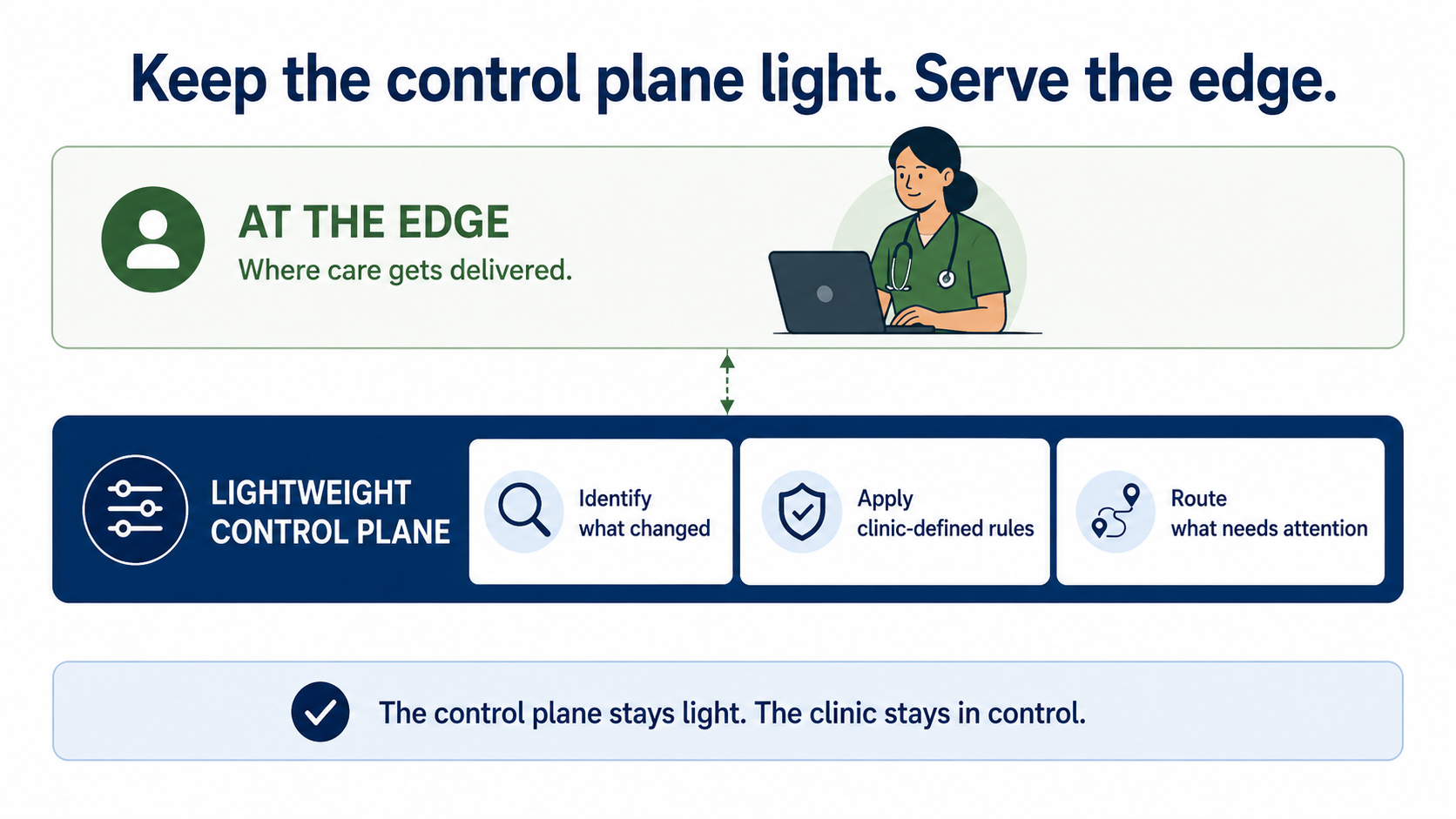
Technology should assemble the patient’s longitudinal story, separate current information from copied history, identify meaningful changes, surface unresolved needs, prioritize patients requiring attention, route work to the appropriate role, track whether the work was completed, and preserve human judgment where it matters.
This creates leverage without sacrificing care.
Instead of using highly trained people to find the work, the system prepares the record and brings the right work to them.
The operating model itself can change
In our work with outpatient clinics, we have seen the potential to reduce administrative effort by more than 60% while helping clinics identify and deliver services that otherwise may be missed.
But the larger opportunity is not one workflow or one financial result. It is the possibility of changing the relationship between complexity and cost.
More complexity → better organized information → earlier intervention → more focused human action
Longitudinal care needs infrastructure that can understand what has happened across time, use data and AI together to reconstruct the patient’s evolving story, and turn that understanding into coordinated work.
Healthcare does not simply need more data—or AI placed indiscriminately on top of more data.
It needs a system that can find the signal, preserve the evidence behind it, and bring the right action to the right person.
That is the foundation of both better care and a lower-cost operating model for longitudinal care.